2026’s Your Ultimate Guide for B2B Growth Strategies
Table of Contents
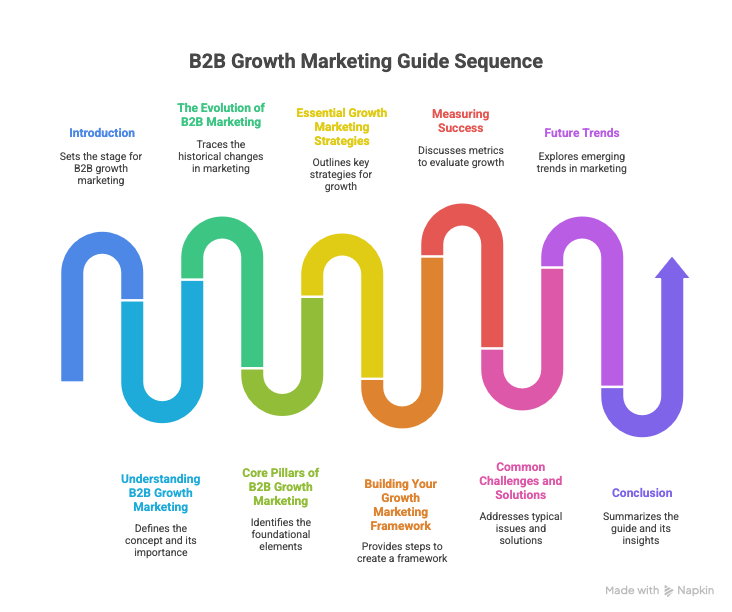
- Introduction
- Understanding B2B Growth Marketing
- The Evolution of B2B Marketing
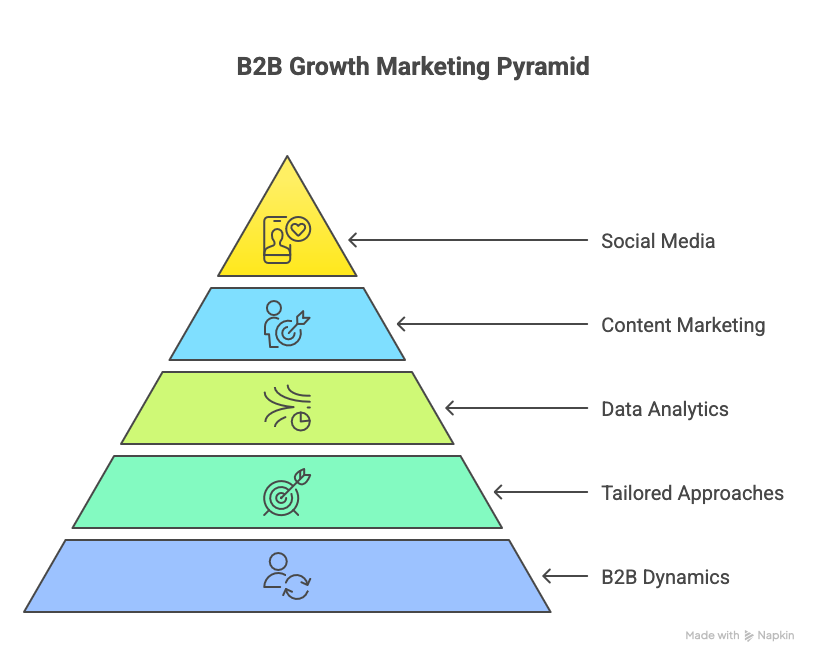
- Core Pillars of B2B Growth Marketing
- Essential Growth Marketing Strategies
- Building Your Growth Marketing Framework
- Measuring Success
- Common Challenges and Solutions
- Future Trends
- Conclusion
Introduction
In today’s rapidly evolving business landscape, traditional marketing approaches are no longer sufficient to drive sustainable growth. B2B companies face unique challenges: longer sales cycles, multiple decision-makers, and increasingly sophisticated buyers who conduct extensive research before engaging with sales teams.
B2B growth marketing represents a fundamental shift in how businesses approach customer acquisition and retention. Rather than viewing marketing as a series of disconnected campaigns, growth marketing takes a holistic, data-driven approach that optimizes every stage of the customer journey.
This comprehensive guide explores the strategies, tactics, and frameworks that successful B2B companies use to drive scalable, predictable growth. Whether you’re a startup looking to establish product-market fit or an established enterprise seeking to optimize your marketing operations, this guide will provide actionable insights to accelerate your growth trajectory.
Understanding B2B Growth Marketing
What is B2B Growth Marketing?
B2B growth marketing is a strategic approach that combines customer acquisition, activation, retention, and expansion strategies to drive sustainable business growth. Unlike traditional marketing that often focuses primarily on lead generation, growth marketing encompasses the entire customer lifecycle, from initial awareness through advocacy.
At its core, growth marketing is characterized by:
- Data-driven decision making: Every strategy is informed by quantitative and qualitative data
- Experimentation mindset: Continuous testing and optimization across all channels
- Full-funnel thinking: Addressing every stage of the customer journey
- Cross-functional collaboration: Breaking down silos between marketing, sales, product, and customer success
- Focus on metrics that matter: Prioritizing retention, lifetime value, and revenue over vanity metrics
How Growth Marketing Differs from Traditional Marketing
Traditional B2B marketing typically operates in campaign-based cycles, focusing on brand awareness and lead generation. Growth marketing, by contrast, operates continuously, with teams constantly experimenting, measuring, and optimizing.
Traditional Marketing Approach:
- Campaign-focused with defined start and end dates
- Emphasis on brand building and awareness
- Success measured primarily by leads generated
- Often siloed from sales and product teams
- Annual or quarterly planning cycles
Growth Marketing Approach:
- Always-on optimization and experimentation
- Emphasis on customer acquisition, retention, and expansion
- Success measured by revenue impact and customer lifetime value
- Deeply integrated with sales, product, and customer success
- Agile planning with rapid iteration cycles
The Evolution of B2B Marketing
From Interruption to Permission
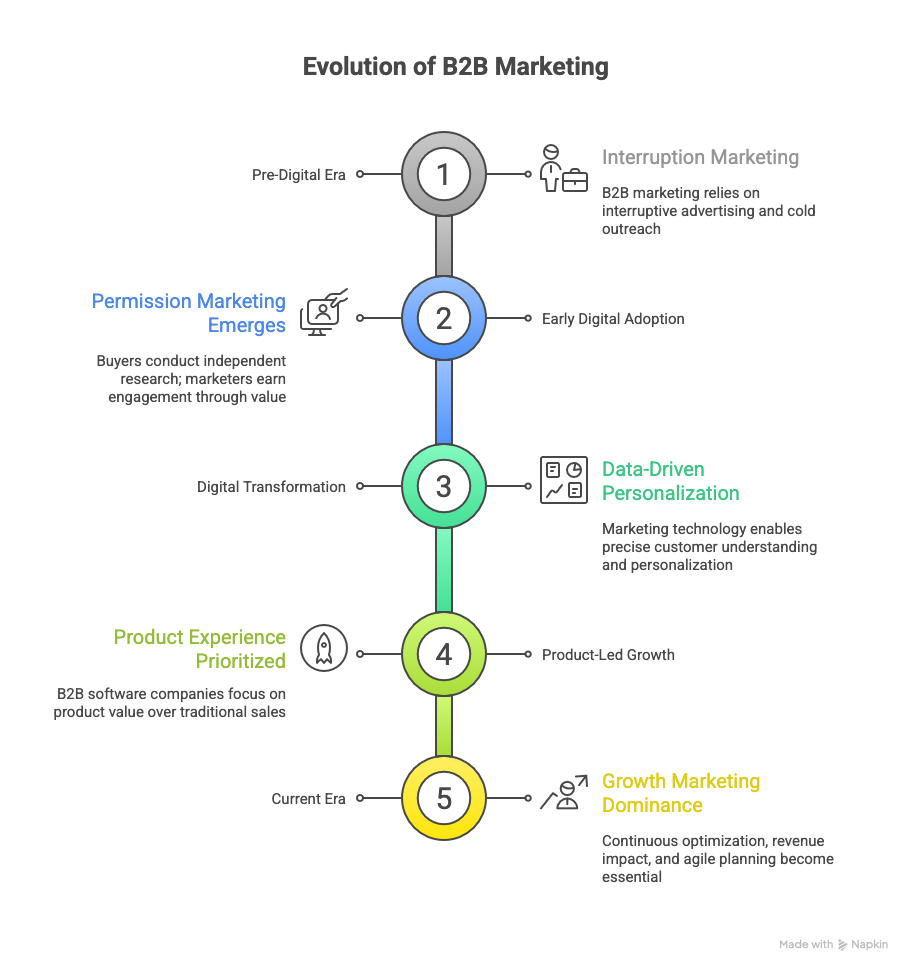
The shift from traditional to growth-focused marketing reflects broader changes in buyer behavior and technology. B2B buyers now conduct 70% of their research independently before engaging with vendors. This means the old playbook of interruptive advertising and cold outreach has diminishing returns.
Growth marketing acknowledges this reality by creating value at every touchpoint. Instead of interrupting potential buyers, growth marketers earn permission to engage by providing genuinely useful content, tools, and experiences.
The Digital Transformation Imperative
Digital channels have fundamentally changed how B2B companies go to market. The proliferation of marketing technology has created unprecedented opportunities to understand customer behavior, personalize experiences, and measure impact with precision.
However, technology alone isn’t the answer. The most successful B2B growth marketers combine sophisticated tools with deep customer insights and a willingness to experiment and learn quickly.
Why This Shift Matters Now
Several factors are converging to make growth marketing essential for B2B success:
- Increased Competition: Lower barriers to entry mean more competitors vying for attention
- Rising Customer Acquisition Costs: Paid channels are becoming more expensive across the board
- Demand for ROI: CFOs and boards expect marketing to demonstrate clear revenue impact
- Product-Led Growth: Many B2B software companies now prioritize product experience over traditional sales
- Economic Uncertainty: Companies must maximize efficiency and prove value for every marketing dollar spent
Core Pillars of B2B Growth Marketing
Pillar 1: Customer Acquisition
Customer acquisition in B2B growth marketing goes beyond generating leads. It’s about attracting the right prospects, engaging them with relevant content and experiences, and efficiently converting them into paying customers.
Key Components:
Target Audience Definition Growth marketing begins with a crystal-clear understanding of your ideal customer profile (ICP). This goes beyond basic firmographics to include behavioral characteristics, pain points, buying processes, and decision-making criteria.
Channel Strategy Successful B2B growth marketers develop expertise in multiple channels while identifying the two or three that drive the majority of qualified pipeline. Common high-impact channels include:
- Search engine marketing (SEO and paid search)
- Content marketing and thought leadership
- LinkedIn and other social platforms
- Account-based marketing programs
- Strategic partnerships and integrations
- Product-led growth motions
Conversion Optimization Every touchpoint in the acquisition journey should be continuously tested and optimized. This includes website design, landing pages, calls-to-action, form fields, email sequences, and sales follow-up processes.
Pillar 2: Activation and Onboarding
Getting customers to sign up or make a purchase is just the beginning. Activation ensures that new customers quickly experience value from your product or service.
Critical Success Factors:
- Time-to-Value: Minimize the time between purchase and first meaningful outcome
- Guided Experiences: Provide clear paths to success through tutorials, templates, and personalized recommendations
- Progress Tracking: Help customers understand where they are in their journey and what to do next
- Success Milestones: Identify and celebrate key achievements that predict long-term retention
Pillar 3: Retention and Engagement
Acquiring customers is expensive. Retaining them is far more cost-effective and drives higher lifetime value. Growth marketers obsess over retention because it’s often the biggest lever for improving unit economics.
Retention Strategies:
Proactive Customer Success Move beyond reactive support to anticipate customer needs, identify at-risk accounts, and drive product adoption through education and enablement.
Product-Market Fit Optimization Continuously gather feedback to improve product-market fit. The strongest retention strategy is building something customers genuinely need and love.
Community Building Create spaces for customers to connect, share best practices, and learn from each other. Strong communities increase switching costs and create network effects.
Regular Value Demonstration Consistently communicate the value customers are receiving through usage reports, ROI calculations, and success stories.
Pillar 4: Revenue Expansion
The most efficient growth often comes from existing customers. Expansion revenue through upsells, cross-sells, and upgrades typically has higher margins and faster sales cycles than new customer acquisition.
Expansion Tactics:
- Usage-Based Pricing: Align pricing with value so growth in customer usage naturally drives revenue growth
- Strategic Upsells: Identify accounts that would benefit from premium features or higher-tier plans
- Cross-Selling: Introduce complementary products or services that solve adjacent problems
- Advocacy Programs: Turn satisfied customers into active promoters who refer new business
Essential Growth Marketing Strategies
Strategy 1: Account-Based Marketing (ABM)
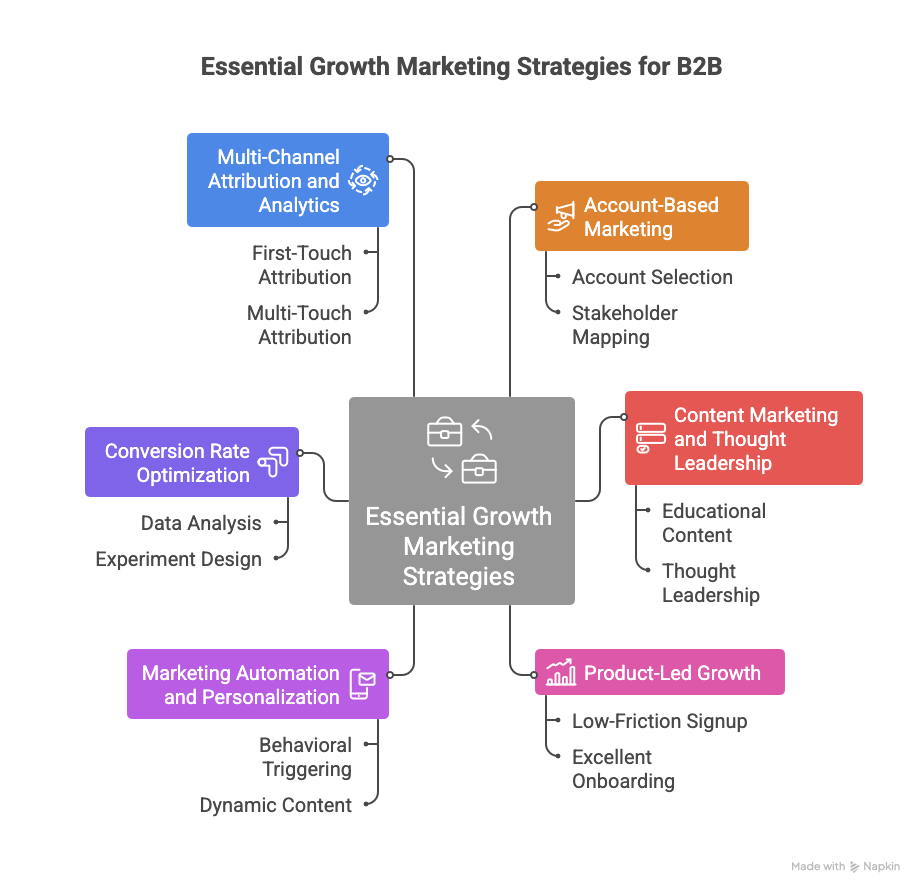
Account-based marketing flips traditional lead generation on its head. Instead of casting a wide net and qualifying leads, ABM identifies high-value target accounts upfront and orchestrates personalized campaigns to engage multiple stakeholders within those organizations.
ABM Implementation Framework:
- Account Selection: Identify and prioritize target accounts based on fit and revenue potential
- Stakeholder Mapping: Research key decision-makers and influencers within each account
- Personalized Campaigns: Create tailored content and experiences for each account
- Multi-Channel Orchestration: Coordinate touchpoints across email, social, advertising, direct mail, and events
- Sales Alignment: Ensure sales teams are deeply involved in strategy and execution
- Measurement: Track account-level engagement and pipeline progression
When ABM Works Best:
- Higher average contract values justify the investment
- Complex sales processes with multiple decision-makers
- Well-defined target market with identifiable key accounts
- Strong alignment between marketing and sales teams
Strategy 2: Content Marketing and Thought Leadership
B2B buyers consume extensive content during their research process. Effective content marketing positions your company as a trusted advisor while driving organic visibility and generating qualified leads.
Content Marketing Excellence:
Educational Content Create comprehensive resources that help prospects understand their problems and evaluate solutions. This includes:
- In-depth guides and whitepapers
- Comparison frameworks
- Industry research and benchmark reports
- How-to tutorials and best practices
Thought Leadership Establish executives and subject matter experts as authoritative voices in your space through:
- Original research and data analysis
- Commentary on industry trends
- Guest articles in respected publications
- Speaking engagements and webinars
SEO Optimization Ensure content is discoverable by optimizing for relevant keywords, earning quality backlinks, and maintaining technical SEO best practices.
Strategy 3: Product-Led Growth
Product-led growth (PLG) uses the product itself as the primary driver of customer acquisition, activation, and expansion. Rather than relying on sales teams to close every deal, PLG allows customers to experience value directly through self-serve trials or freemium offerings.
PLG Components:
- Low-Friction Signup: Remove barriers to getting started with minimal required information
- Excellent Onboarding: Guide new users to their first “aha moment” as quickly as possible
- Virality Mechanisms: Build collaboration and sharing features that naturally drive word-of-mouth
- Expansion Paths: Create clear upgrade prompts when users hit feature or usage limits
- Data-Driven Optimization: Use product analytics to identify friction points and opportunities
PLG Considerations:
Product-led growth works best when your product has broad appeal, can demonstrate value quickly, and has relatively low complexity for initial use cases. It requires significant product and engineering investment but can dramatically lower customer acquisition costs at scale.
Strategy 4: Marketing Automation and Personalization
Modern B2B buyers expect personalized experiences. Marketing automation enables you to deliver relevant content and timely outreach at scale based on behavior, firmographics, and engagement history.
Automation Best Practices:
Behavioral Triggering Set up automated workflows triggered by specific actions like content downloads, product usage patterns, or email engagement.
Lead Scoring and Grading Implement sophisticated scoring models that consider both explicit (firmographic) and implicit (behavioral) signals to prioritize sales follow-up.
Dynamic Content Personalize website content, emails, and landing pages based on industry, company size, role, or previous interactions.
Lifecycle Nurturing Develop automated email sequences tailored to different buyer stages and personas that provide value while advancing prospects through the funnel.
Strategy 5: Conversion Rate Optimization (CRO)
Small improvements in conversion rates compound to create significant revenue impact. CRO applies systematic experimentation to improve performance at critical conversion points.
CRO Methodology:
- Data Analysis: Identify conversion bottlenecks through analytics and user research
- Hypothesis Formation: Develop testable hypotheses about what changes will improve performance
- Experiment Design: Create A/B or multivariate tests to validate hypotheses
- Implementation: Run experiments with statistical rigor
- Learning Capture: Document results and insights to inform future optimization
High-Impact Areas to Optimize:
- Landing page messaging and design
- Form fields and friction points
- Call-to-action copy and placement
- Email subject lines and content
- Trial signup and onboarding flows
- Pricing page presentation
Strategy 6: Multi-Channel Attribution and Analytics
Understanding which marketing activities drive revenue is essential for optimal resource allocation. Multi-channel attribution helps you move beyond simplistic last-click models to understand the full customer journey.
Attribution Approaches:
First-Touch Attribution: Credits the initial interaction that brought someone into your funnel Last-Touch Attribution: Credits the final interaction before conversion Multi-Touch Attribution: Distributes credit across multiple touchpoints based on their influence Time-Decay Models: Gives more credit to recent interactions Algorithmic Attribution: Uses machine learning to determine optimal credit distribution
The right attribution model depends on your sales cycle length, typical customer journey, and organizational needs. Most B2B companies benefit from implementing multi-touch attribution with the flexibility to view data through different lenses.
Building Your Growth Marketing Framework
Step 1: Establish Your North Star Metric
Your North Star Metric is the single metric that best captures the core value you deliver to customers. For B2B companies, this is typically closely tied to product usage or customer success outcomes rather than vanity metrics like traffic or raw leads.
Examples of Strong North Star Metrics:
- Active users achieving a key outcome each week
- Revenue processed through your platform
- Successful projects or transactions completed
- Time saved or efficiency gained for customers
Your North Star should be leading (predicts future revenue), actionable (teams can influence it), and understandable (everyone grasps why it matters).
Step 2: Map the Customer Journey
Create detailed maps of how customers move from awareness to advocacy, identifying:
- Key stages and milestones
- Typical timeframes between stages
- Main touchpoints and interactions at each stage
- Common objections and friction points
- Metrics that indicate progress or stagnation
This journey map becomes the foundation for prioritizing growth initiatives and identifying optimization opportunities.
Step 3: Build Your Growth Team
Effective growth marketing requires cross-functional collaboration. The ideal growth team includes:
Core Roles:
- Growth Marketing Manager/Director (strategy and coordination)
- Data Analyst (measurement and insights)
- Content Marketer (thought leadership and education)
- Demand Generation Specialist (campaigns and lead generation)
- Marketing Operations (automation and technology)
Critical Partners:
- Sales (alignment on ICP and messaging)
- Product (feedback loop and PLG initiatives)
- Customer Success (retention insights and expansion opportunities)
Step 4: Implement Your Marketing Stack
The right technology enables scalability, measurement, and personalization. Essential categories include:
Foundation:
- CRM (Salesforce, HubSpot, etc.)
- Marketing automation platform
- Website analytics
Specialized Tools:
- Account-based marketing platforms
- Content management systems
- SEO and content optimization tools
- Product analytics
- Customer data platforms
- A/B testing and experimentation tools
Choose tools that integrate well together to create a cohesive data ecosystem. Avoid over-complicating your stack, especially in early stages.
Step 5: Establish Your Experimentation Cadence
Growth marketing thrives on rapid testing and learning. Establish clear processes for:
- Generating experiment ideas
- Prioritizing based on potential impact and effort
- Designing statistically valid tests
- Running experiments to completion
- Documenting and sharing learnings
- Implementing successful experiments at scale
Most high-performing growth teams run multiple experiments simultaneously across different parts of the funnel, with clear ownership and accountability for each test.
Step 6: Create Feedback Loops
Systematic learning requires capturing insights and making them accessible across the organization. Implement:
Regular Review Cadences:
- Weekly: Review active experiments and key metrics
- Monthly: Deep-dive into channel performance and cohort analysis
- Quarterly: Strategic planning and goal-setting
Documentation Systems:
- Centralized repository of experiment results
- Customer research and feedback summaries
- Win/loss analysis from closed deals
- Competitive intelligence updates
Cross-Functional Sharing:
- Regular sharing sessions between marketing, sales, and product
- Customer advisory boards and feedback programs
- Internal newsletters highlighting key learnings
Measuring Success
Key Performance Indicators (KPIs) for Growth Marketing
Different stages of the customer journey require different metrics. Here’s a comprehensive framework:
Acquisition Metrics:
- Marketing Qualified Leads (MQLs)
- Sales Qualified Leads (SQLs)
- Cost Per Lead (CPL)
- Cost Per Acquisition (CPA)
- Lead-to-Opportunity Conversion Rate
- Opportunity-to-Customer Conversion Rate
Activation Metrics:
- Trial Signup Rate
- Activation Rate (reaching key value milestones)
- Time to First Value
- Onboarding Completion Rate
Retention Metrics:
- Net Revenue Retention (NRR)
- Gross Revenue Retention (GRR)
- Customer Churn Rate
- Logo Churn Rate
- Product Usage Metrics
- Net Promoter Score (NPS)
Revenue Metrics:
- Customer Lifetime Value (LTV)
- LTV:CAC Ratio
- Average Contract Value (ACV)
- Expansion Revenue
- Payback Period
Advanced Analytics for Growth Marketers
Beyond basic KPIs, sophisticated growth marketers leverage:
Cohort Analysis: Track how different customer cohorts perform over time to understand trends in retention, engagement, and expansion.
Funnel Analysis: Identify conversion rates and drop-off points at each stage of your funnel to prioritize optimization efforts.
Customer Segmentation: Group customers by characteristics and behavior to tailor strategies and measure performance across segments.
Predictive Modeling: Use historical data and machine learning to predict which leads are most likely to convert or which customers are at risk of churning.
Aligning Metrics with Business Goals
The best metrics are those that directly tie to business outcomes. When presenting to executives or boards, translate marketing metrics into business impact:
- Instead of “generated 500 MQLs,” say “generated $2M in qualified pipeline”
- Instead of “improved conversion rate by 15%,” say “this optimization will contribute $500K in ARR this quarter”
- Instead of “increased content downloads by 40%,” say “content program drove 30% of closed-won deals last quarter”
This translation builds credibility and ensures continued investment in growth initiatives.
Common Challenges and Solutions
Challenge 1: Aligning Marketing and Sales
The Problem: Marketing and sales misalignment is one of the most common growth inhibitors. When these teams aren’t working in lockstep, you get finger-pointing about lead quality, wasted budget on unqualified leads, and missed revenue targets.
The Solution:
- Shared Definitions: Agree on what constitutes an MQL, SQL, and opportunity
- Service Level Agreements: Set clear expectations for lead follow-up speed and quality
- Joint Planning: Include sales in marketing strategy development and vice versa
- Unified Metrics: Hold both teams accountable to revenue and pipeline goals
- Regular Communication: Establish weekly sync meetings to review performance and address issues
- Closed-Loop Reporting: Ensure marketing sees what happens to leads after handoff
Challenge 2: Proving ROI with Long Sales Cycles
The Problem: B2B sales cycles can span 6-18 months or longer. This makes it difficult to connect marketing activities to closed revenue and demonstrate short-term ROI.
The Solution:
- Track Leading Indicators: Focus on pipeline generation and pipeline velocity, not just closed deals
- Implement Multi-Touch Attribution: Understand marketing’s influence across the entire journey
- Use Pipeline Stage Progression: Measure how marketing accelerates deals through stages
- Benchmark Against Targets: Compare pipeline generation to what’s needed to hit revenue goals
- Communicate Early Impact: Show influence on opportunity creation and pipeline growth before deals close
Challenge 3: Creating Enough Quality Content
The Problem: Effective content marketing requires consistent production of high-quality, relevant content. Many teams struggle to maintain the volume and quality needed.
The Solution:
- Repurpose Strategically: Turn one piece of cornerstone content into multiple formats
- Leverage Subject Matter Experts: Interview internal experts rather than having marketers write everything
- User-Generated Content: Encourage customers to create case studies, reviews, and testimonials
- Curate Industry Content: Add value by aggregating and commenting on relevant external content
- Content Calendar: Plan content in advance aligned with campaigns and customer needs
- Quality Over Quantity: Focus on creating truly excellent pieces rather than high-volume mediocre content
Challenge 4: Maintaining Growth at Scale
The Problem: Tactics that work at small scale often break as you grow. Channels become saturated, costs increase, and maintaining growth rate becomes increasingly difficult.
The Solution:
- Diversify Channels: Don’t become over-reliant on any single acquisition channel
- Optimize for Efficiency: Continuously improve conversion rates and reduce customer acquisition costs
- Build Brand: Invest in brand awareness to create a more efficient acquisition engine over time
- Leverage Existing Customers: Focus more on retention and expansion as you scale
- Enter New Markets: Expand into adjacent segments or geographies
- Product-Led Growth: Let the product drive organic growth through virality and word-of-mouth
Challenge 5: Data Overload and Analysis Paralysis
The Problem: With so much data available, it’s easy to become overwhelmed or spend all your time analyzing rather than taking action.
The Solution:
- Focus on Metrics That Matter: Identify your core KPIs and check them regularly
- Set Clear Decision Criteria: Determine in advance what results would drive specific actions
- Timebox Analysis: Give yourself limited time to analyze data before making decisions
- Trust Your Expertise: Combine data with intuition and experience
- Start Small: Run small tests to get directional data rather than waiting for perfect information
- Automate Reporting: Set up dashboards that surface key metrics without manual work
Future Trends in B2B Growth Marketing
Artificial Intelligence and Machine Learning
AI is transforming growth marketing across multiple dimensions:
Predictive Analytics: Machine learning models can predict which leads are most likely to convert, which customers might churn, and which accounts represent the best expansion opportunities. This enables smarter resource allocation and more proactive intervention.
Personalization at Scale: AI enables hyper-personalized experiences by analyzing vast amounts of data to determine optimal content, messaging, and timing for each prospect and customer.
Content Generation: While human creativity remains essential, AI tools are increasingly helping marketers generate first drafts, optimize copy, and create variations for testing.
Chatbots and Conversational Marketing: Intelligent chatbots can qualify leads, answer questions, and book meetings 24/7, dramatically improving response times and conversion rates.
Marketing Automation: AI is making marketing automation more sophisticated, with systems that can dynamically adjust campaigns based on real-time engagement and behavior patterns.
Privacy-First Marketing
Changes in data privacy regulations and the deprecation of third-party cookies are forcing marketers to adapt:
First-Party Data Strategy: Building direct relationships and collecting consented first-party data is becoming paramount. This includes gated content, account creation, and preference centers.
Contextual Targeting: Without behavioral tracking, contextual targeting based on content and intent signals will become more important.
Value Exchange: Customers will expect clear value in exchange for their data. Transparency and trust will differentiate winners from losers.
Community-Led Growth
Building engaged communities around your product or category can create powerful network effects:
Peer Learning: Customers increasingly prefer learning from peers rather than vendors. Creating spaces for these connections builds loyalty and reduces support costs.
User-Generated Content: Community members can create content, answer questions, and evangelize your product more authentically than any marketing team.
Product Co-Creation: Engaged communities provide valuable product feedback and can help guide your roadmap.
Revenue Operations (RevOps)
The silos between marketing, sales, and customer success are breaking down:
Unified Data and Systems: RevOps creates a single source of truth for customer data across the entire revenue organization.
Shared Goals and Metrics: Instead of each function optimizing for its own metrics, RevOps aligns everyone around revenue outcomes.
Process Optimization: RevOps identifies and eliminates friction across the entire customer lifecycle, from first touch to expansion.
Video and Interactive Content
Content consumption preferences are shifting toward more engaging formats:
Short-Form Video: Platforms like LinkedIn and YouTube Shorts are creating opportunities for quick, impactful video content.
Webinars and Virtual Events: The normalization of remote work has made virtual events a permanent part of the B2B marketing mix.
Interactive Tools: Calculators, assessments, and configurators provide value while capturing valuable data about prospects’ needs and priorities.
Conclusion
B2B growth marketing represents a fundamental evolution in how businesses drive sustainable revenue growth. By taking a data-driven, customer-centric approach that optimizes the entire lifecycle from acquisition through advocacy, growth marketers achieve results that traditional approaches simply cannot match.
The key principles to remember:
Think Holistically: Growth doesn’t stop at customer acquisition. Retention and expansion are equally important and often more impactful on unit economics.
Embrace Experimentation: The best growth marketers are constantly testing, learning, and iterating. Not every experiment will succeed, but systematic experimentation drives continuous improvement.
Align Cross-Functionally: Breaking down silos between marketing, sales, product, and customer success is essential. Growth happens at the intersections.
Lead with Data: Gut instinct has its place, but data should inform strategy and prioritization. Measure what matters and let results guide decisions.
Focus on Value: The most sustainable growth comes from genuinely solving customer problems and delivering exceptional value. No amount of marketing tactics can compensate for poor product-market fit.
Stay Customer-Centric: Everything should start with a deep understanding of your customers—their challenges, goals, and decision-making processes.
Getting started with growth marketing doesn’t require a complete organizational transformation overnight. Begin by:
- Identifying your North Star Metric
- Mapping your current customer journey
- Establishing baseline metrics across the funnel
- Running your first experiments in high-impact areas
- Building feedback loops to capture and share learnings
- Gradually expanding your growth marketing capabilities
The competitive landscape will continue to evolve, but the fundamental principles of growth marketing—creating value, measuring impact, and continuously optimizing—will remain essential for B2B success.
Whether you’re building a growth function from scratch or optimizing an existing program, the strategies and frameworks in this guide provide a roadmap for driving predictable, scalable growth. The journey requires patience, persistence, and a commitment to learning, but the results are worth the investment.
Additional Resources
Recommended Reading:
- “Hacking Growth” by Sean Ellis and Morgan Brown
- “The Lean Startup” by Eric Ries
- “Traction” by Gabriel Weinberg and Justin Mares
- “Predictable Revenue” by Aaron Ross
- “Product-Led Growth” by Wes Bush
Communities and Forums:
- GrowthHackers
- RevGenius
- Product Marketing Alliance
- Pavilion (formerly Revenue Collective)
Tools to Explore:
- Analytics: Google Analytics, Mixpanel, Amplitude
- Marketing Automation: HubSpot, Marketo, Pardot
- ABM Platforms: Demandbase, 6sense, Terminus
- Experimentation: Optimizely, VWO, Google Optimize
- SEO: Ahrefs, SEMrush, Moz
Key Metrics to Track:
- Customer Acquisition Cost (CAC)
- Customer Lifetime Value (LTV)
- LTV:CAC Ratio
- Payback Period
- Net Revenue Retention
- Pipeline Velocity
- Conversion Rates by Funnel Stage
The most successful B2B growth marketers never stop learning. Stay curious, keep testing, and always put your customers at the center of everything you do.


Leave a Reply